Why Aceso
Aceso — pronounced “Ah-keso,” named for the Greek goddess of healing — puts agentic AI into the room itself. The Aceso Sphere platform doesn’t just display information; it understands the moment, acts on it, and closes the loop for patients and care teams. Every Aceso product runs on it.
An AI-powered Conscious Room, built on a patented, proven, real-world-effective platform — pairing the benefits of the latest AI with the reliability, usability, and 15-plus years of proven results of the Aceso Sphere.
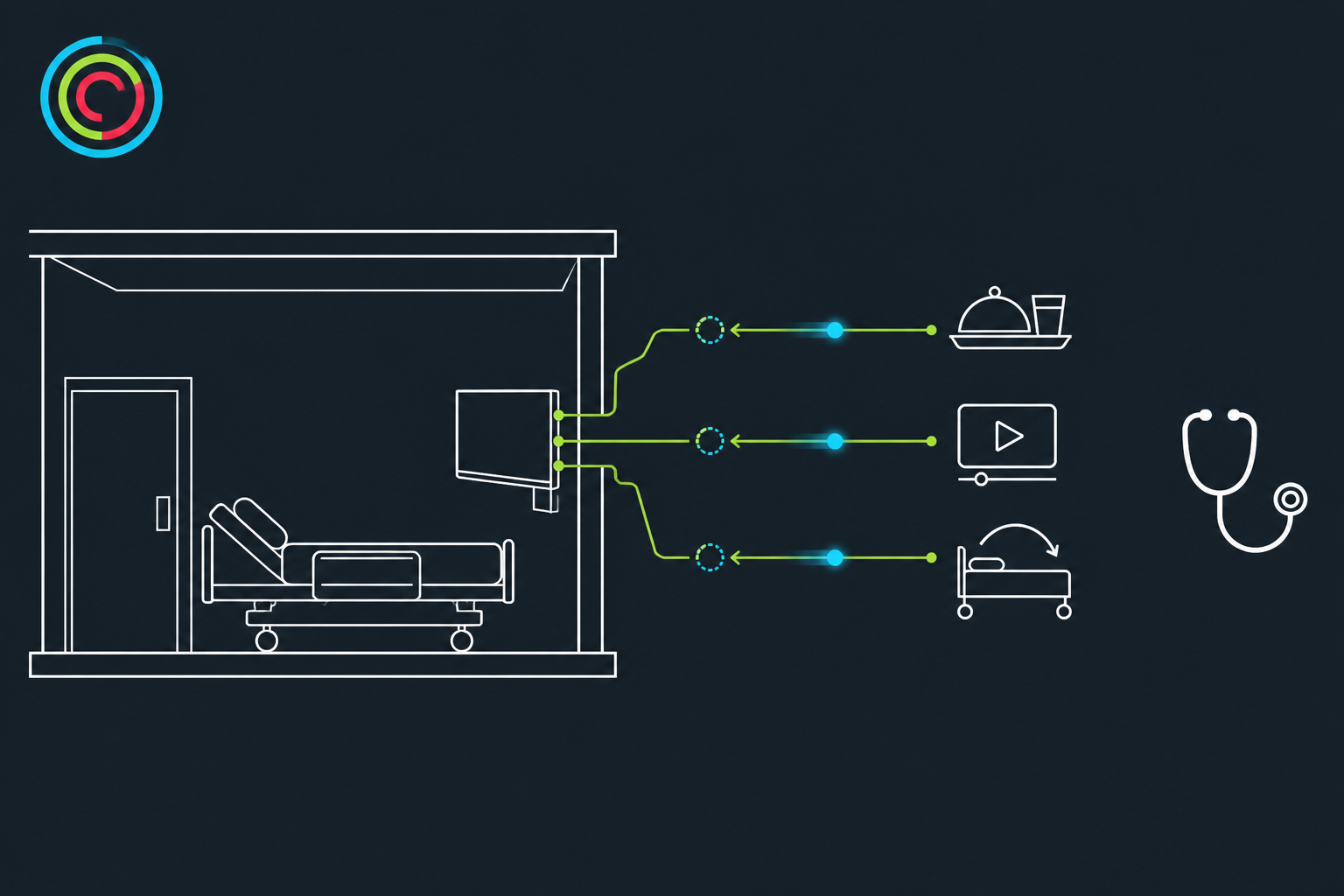
The clearest proof of Aceso’s AI is the Conscious Room: the patient room becomes an active participant in care. It listens, understands what the patient needs, responds in the moment, and quietly hands the care team what they need to know — no new hardware, on the screen already in the room.

Anyone can put a tablet on the wall. What separates Aceso from the also-rans is the intelligence and the foundation beneath it — capabilities that are easy to overlook on a demo day, quietly decisive at 3 a.m. on a live unit, and genuinely hard to engineer at hospital scale. Here are a few, and why each one matters more than it looks.
Platform technology that surfaces what matters in the moment — for the patient, the care team, and the room — so nothing important stays hidden and no one has to go looking for it.
Back-end integration that quietly informs and coordinates everyone around the patient, keeping the whole team on the same plan without adding another screen to check or alert to chase.
Functionality — and agentic AI — that resolves patient and care-team needs proactively, closing the loop before small gaps become friction, delay, or risk.
Aceso meets every patient where they are — presenting information at the right reading level and in their language, and letting them control the room and reach their team without a manual. The result is greater adoption, fewer care-team disruptions, and a patient who always knows their status and what comes next.
A family arrives in a busy ICU. The care team is heads-down, the patient is asleep, and the old whiteboard is half-erased and out of date — but the room itself shows them, clearly and calmly, exactly where things stand.
The room’s displays sense time of day, ambient light, and patient state, and quietly adjust brightness — bright and legible for rounds, soft and non-intrusive for rest, dark enough not to interrupt sleep.
It’s 2 a.m. A recovering patient finally drifts off — and stays asleep, because the screen faded itself down instead of glaring at the ceiling all night. Rest is not a nicety; it is where healing happens.
Patients control the room and reach their care team by voice, touch, or simple ambient cues — designed for people who are tired, in pain, hard of hearing, low-vision, or not fluent in English.
A patient who can’t reach the call button, or can’t read the menu, still gets water, still dims the lights, still says “I’m in pain” — and is heard the first time.
Sphere routes the right signal to the right person on the right device, and stays silent in the room — no beeping wall unit, no alarm the patient learns to ignore. Urgency is inferred from context, not broadcast.
A nurse gets the one alert that matters, on the phone in her pocket, while the patient sleeps through the night undisturbed. The room stays calm; the care team stays informed.
When the network hiccups or a service goes down, the room keeps working. Core functions run locally and reconcile automatically when connectivity returns — no black screen, no dead call button.
The Wi-Fi drops on a busy floor. The patient still calls for help, the board still shows the plan, and nobody on the unit even notices there was an outage.
Sphere unifies the EHR, nurse call, RTLS, environmental controls, and more into a single curb-to-bedside view — so the room reflects one coherent picture instead of a pile of disconnected systems.
A charge nurse sees the whole unit — plan, status, needs, and who’s where — on one board, instead of stitching it together from five logins and a whiteboard marker.
Every device across every unit and campus is monitored, updated, and managed centrally — health, configuration, and content pushed and verified remotely, without a truck roll to each room.
IT rolls a security patch to 4,000 rooms across six hospitals overnight, confirms every one landed, and no clinician ever knew it happened.
No PHI rests on the glass. The platform is architected so sensitive data is minimized, protected in transit and at rest, and access is scoped and audited — secure by default, not by configuration.
A visitor walks past an occupied room and sees a welcoming display — not the patient’s diagnosis. The clinician, badged in, sees exactly what they’re cleared to see.
Aceso has run in real hospitals for over fifteen years. The eCareBoard — one product on the Sphere platform — has the field evidence to show for it.
If a patient has had an acute change I can look up and see the emergency contact information rather than having to search the chart.
Administrators and key ancillary staff don’t have easy access to the patient records, so information on the eCareBoard gives a concise snapshot of what’s going on. They can do their rounds more efficiently.
Being in the hospital is a stressful time, and patients and families don’t have much tolerance for learning complicated new systems. They don’t have to be taught how to use this — it automatically shares important information.